Since there seems to be some confusion about the existence (or lack thereof) of “sustained and effective critique of Ai,” I would point out there is an entire conference dedicated to it this week in the 4th Annual Civics of Technology Online Conference: Communal Resistance to Artificial Systems. Two of the many sustained and effective voices who have long held a “rich, vigorous, counter conversation to Ai hype” are keynotes: Audrey Watters and Chris Gilliard. The sessions and panels are packed with a Who’s Who of Ai questioners and critiquers, so if you are not sure where the pushback is – take a look. It is free to join online I believe.
(And oh look – an Ai critic that we were told is “largely unheard now” and “completely faded from public dialogue other than in a small camp” is still out there sustaining effective critique of Ai to a very large camp…)
Of course, the question is not really whether or not there is critique – it is really more of will the hypesters and thought leaders actually take the risk in promoting those that disagree with themselves? Will people that write newsletters constantly promoting the future of Ai (while barely covering any of the harms) say as much about this conference as they will, say, Mark Cuban claiming Ai will end teaching as we know it?
No, of course Cuban’s statements will get more coverage as “proof” that Ai is inevitable, despite the fact that he has no expertise in the field of education. If I went around talking about the future of entrepreneurship or business trends or what not, most people would dismiss me because I have not studied the field. But billionaires can say what they want to about education and because they might have run an Ed Tech company no one will bat an eye at taking their word for it. Money talks.
What do you call it when someone talks about a field they aren’t an expert in as if they were? Vibe thought leading?
I wish someone would ask Cuban what “teaching like it’s 2024” even looks like, because in the history of education I don’t think “teaching” has ever looked like one thing across the board in one given year. Certainly today if you walk in different classrooms you are going to see different things. That was even true 25 years ago when I taught 8th grade Science: my classroom was completely different than the 8th grade English classroom, as well as a 10th grade Science classroom or a 4th grade Science classroom.
This idea that “education” or “teaching” is this monolithic entity that looks the same every single place it occurs, and hasn’t changed for a hundred years just isn’t accurate. People that promote this idea reveal they really don’t know much about educational trends or the current state of classrooms. Nor are they spending time in a sustained conversation with teachers about what really happens in said classrooms.
Another thing I would push back on with Cuban is this idea that “answers by students can be generated by a model.” The whole idea of “if Ai can pass your class” or “if Ai can answer your questions” given as a sign that you are doing teaching wrong vastly misunderstands how learning occurs. We are well over two decades into an era of having most answers being found easily by an Internet search. In fact, when I was teaching in 2001, I remember being told that because of the “rise of Google Search,” teaching like its 2001 would need to change or my job would go away. The current Ai Panic is just the Google Panic rehashed: students can easily find answers through the interwebs, so teaching will die out. Here we are 25 years later, with a “new” tech being used to prove the same old prophecy.
(Quick note: Ai is not really “new,” and Google has always used Ai FYI…)
A computer being able to give students answers, whether through Google Search or Ai, is not a replacement for learning. Ai is just a pattern recognition system giving you the most likely response to your query. Ai is not intelligence that can “take” a test, or “answer” a question for students by generating a model. When you feed a test or question into Ai, it is not demonstrating learning. It is pattern recognizing a string of words that most likely s the next correct word in the sentence. Neuroscientists have been telling us for a couple of decades that the human brain does not act like a computer, nor does a computer (or database) act like a brain. Ai does not “learn” and it is not “intelligence.”
The other Ai hype you hear often that doesn’t quite match with what is happening at the ground level is the idea that “Higher Ed is slow to adopt / refuses to adopt Ai.”
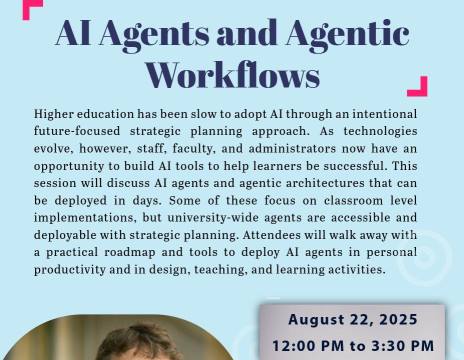
Agentic Ai has been telling people to kill themselves, or others that they are gods. It has been deleting entire company databases, entire student papers, and causing other havoc and then lying about what it did. Not to mention the racist, sexist, transphobic, etc responses it sometimes gives. I wonder why Higher Education is reluctant to adopt potential lawsuit generation tools? Oh, and research is finding that it makes you feel more productive while actually making you less productive.
The weird thing is that when I talk to professors, I get a different story. Ai is being forced on them at a rapid pace without any proof that it works or is even very effective. Some of that is through companies like Google and Microsoft that are doing that to everyone, not just professors. But a lot of it is coming from institutional leadership. The ground level view of Higher Ed Ai adoption seems to be one of rapid adoption. But… is this adoption strategic? Well, about as much as anything else is strategic (which means it is a different story depending on which institution you are talking to). AAUP reports that, yes, Ai is being adopted at universities, and that it is usually a top-down decision with little input from faculty or students.
I know there are those that feel the Ai Questioners are just focusing too much on what little bad news there is out there about Ai. They claim the problems with Ai are few and far between. Is that really the case? There is more bad news than some would lead you to believe. I am just going to scroll through my Bluesky feed to see what people are saying about Ai this past week alone:
- A Substack app pushed an alert promoting a Nazi newsletter
- Flaws in Gemini CLI Ai coding assistant allowed hackers to silently execute malicious attacks
- Apple is being sued over “Ai Washing” – making their Ai seem better than it is
- Hertz’ Ai system That Scans for “Damage” on Rental Cars Is Turning Into an Epic Disaster
- Cheyenne to host massive Ai data center using more electricity than all Wyoming homes combined (small decreases in Ai environmental impacts are typically overshadowed by massive increases in computing “needs” FYI)
- An Ai tool being used by the FDA to speed up drug approvals is making up studies according to employees
- ChatGPT Gives Instructions for Dangerous Pagan Rituals and Devil Worship
- Meta pirated and seeded porn for years to train Ai, lawsuit says
- If You’ve Asked ChatGPT a Legal Question, You May Have Accidentally Doomed Yourself in Court
- The AAUP report that Ai is being adopted at universities with little input from faculty or students probably goes here as well
Well, I said this past week, but I only made it to yesterday before it got too bleak. And this is in a week where all kinds of political issues are dominating the headlines. So this is just the stuff that bubbles up past everything else. I didn’t even touch on all of the surveillance tech that currently doesn’t use Ai, like this drone company that wants to use drones to stop school shooters in Texas. You know that this will be connected with Ai someday – probably at first to solve the problem of what these drones will do every time they get thwarted by a closed door. But someday soon Ai will be making decisions on how and when to deploy these drones – because that is already happening with other drone companies.
 If your source for Ai news and information hasn’t been covering these problems specifically, then I recommend you find a different source. Like I have said many times, I talk to employees at different companies every week that are having ineffective Ai solutions forced on them, decreasing their productivity. Many are being told that Ai usage is a requirement, as they will be evaluated on their yearly evaluations based on how much they utilize Ai. They are told that Ai refusal will be an HR issue, leading to termination if they continue to refuse. You don’t see many articles on this, because few of the Ai Cheerleaders are talking to the ground level employees forced to use Ai.

Matt is currently an Instructional Designer in the private sector and a Part-Time Instructor at the University of Texas Rio Grande Valley. Previously he worked as a Learning Innovation Researcher with the UT Arlington LINK Research Lab. His work focuses on learning theory, Heutagogy, and learner agency. Matt holds a Ph.D. in Learning Technologies from the University of North Texas, a Master of Education in Educational Technology from UT Brownsville, and a Bachelors of Science in Education from Baylor University. His research interests include instructional design, learning pathways, sociocultural theory, heutagogy, virtual reality, and open networked learning. He has a background in instructional design and teaching at both the secondary and university levels and has been an active blogger and conference presenter. He also enjoys networking and collaborative efforts involving faculty, students, administration, and anyone involved in the education process.