To continue the series on a new vision for Learning Management Systems, I want to turn our attention to the new direction that I think the LMS program should go. Instead of going more complex by adding more and more buzzword tools, I want to see LMS companies go the opposite direction: more streamlined. In my opinion, the way to go is a simplified user interface that is focused on active learning, constructivism, and openness.
As I stated in an earlier post about this subject, we need to start seeing the LMS as the control panel of a subway system. As trains go all over the place, they relay information back to the control panel so that the head conductor can know where they are going and what they are picking up on the way. In other words, use the tool to make the instructors job easier while also launching students out on to the web to learn. You can visualize it like this:
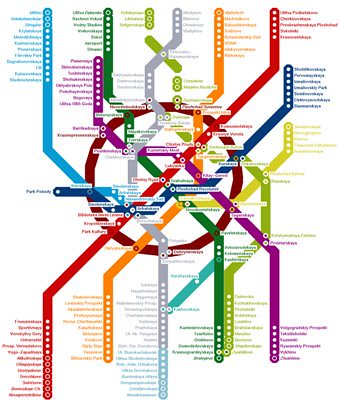
The Learning Management System would become more of a hub than a walled garden or gated castle. Students might go there to view grades or get initial contact information, but leave and go out on to the web to learn and share. Instructors would use the LMS program to track student learning and centralize communications. Think of the dark red circle in the diagram above as the hub. There is some information in that hub, but most of the tracks are heading out in different directions. Information is relayed back to the hub, where the instructor can examine in, critique it, grade it, and send back information to the various tracks.
Some debate may arise over what tools should be “inside” the hub and which ones should be “outside.” To me, a grade book and centralized listserv-like email broadcast system should definitely be in there. The main tool in there should be a dashboard of sorts that collects information and submissions from all over the Internet. This tool would allow the instructor to grade these collections and maybe even share them with other students. Maybe there could even be a closed chat area for interaction that can exclude any outside interface. But I would put every other tools – discussion boards, blogs, wikis, etc. – outside of the circle.
I know that privacy concerns are an issue in moving to an open class like this. In a few classes (and only a very select few) – privacy may need to be considered. However, when students are privately communicating with professors, no one else benefits from the knowledge that is exchanged. And it becomes difficult to bring in outside voices to a closed system. You can always bring guest speakers and debates in to a face-to-face class – why not an online course?
Most online classes that I have worked on were not ready for this level of openness and active learning – but the transition would be pretty easy if needed. So on top of this new vision for Learning Management Systems, we would also need to re-think the design of courses.
The great thing is that most of the technology to create this new vision already exist. They just need to be put together in new ways, which is what I want to blog about next time: what would all of this actually look like.
See other posts in this series

Matt is currently an Instructional Designer II at Orbis Education and a Part-Time Instructor at the University of Texas Rio Grande Valley. Previously he worked as a Learning Innovation Researcher with the UT Arlington LINK Research Lab. His work focuses on learning theory, Heutagogy, and learner agency. Matt holds a Ph.D. in Learning Technologies from the University of North Texas, a Master of Education in Educational Technology from UT Brownsville, and a Bachelors of Science in Education from Baylor University. His research interests include instructional design, learning pathways, sociocultural theory, heutagogy, virtual reality, and open networked learning. He has a background in instructional design and teaching at both the secondary and university levels and has been an active blogger and conference presenter. He also enjoys networking and collaborative efforts involving faculty, students, administration, and anyone involved in the education process.
Hi Matt,
Just bumped into this post. You were almost describing our fully online teacher training programme (21stcenturyeducators.tamk.fi) in the Uni I work with. Two years ago! :) This is exactly how the tech ecosystem has been build in it!
How do you see the situation now? Do you think there has been a lot of change with the LMS’? In my eyes we still have a way to go with this area. Still too much hype about the ed tech, but the actual learning processes people use with the tech, are often left unaddressed.
Anyway, thanks for a great post and an interesting blog!
Hello Marko, and thanks for the comment.
There have been some changes in the LMS market, but in some ways calling them “changes” is a stretch. Often it feels like more of the same. So, I also feel we have a way to go. There is some good work out there on the fringes, which does seem to be slowly creeping into the mainstream.
Thanks for the reply Matt! One thing that I’ve been thinking of is that what’s the overall future of LMS? Where does it stand in the learning process?
If you examine the fast half-life of knowledge, need for critical thinking, information evaluation and innovation: in learning, pre-chewed content without learners evaluating it, searching it and constructing it anew, is a rigid model. Thus we should also be thinking what kind of affordance we need from technology, and how to help it emerge.
Sorry if this sounds like preaching, but been examining this a lot lately, and although my history is in tech and interaction design, I feel often people, researchers, educators, etc. are looking into this the wrong way.