One of the reasons I feel that the EdTech community needs a new vision for the Learning Management System is because I’m not totally comfortable with the two dominant visions that I see out there. Much like in politics, so many seem to fall in to one of two extremes. One extreme is that the LMS is fine the way it is. Some like it this way because they like having a place to securely store a large amount of content. The other side is the one that wants to totally dump the LMS and go totally do-it-yourself. This is where the EduPunks seem to camp – the LMS is too constraining and limiting on their teaching. I suspect that most people are somewhere in the middle – just the same way they are in politics. But they just aren’t sure what that means.
I want to look at what that middle ground means – the position that is calling for change and progress, but doesn’t want to throw out the baby with the bathwater.
So, looking at the need for change, I want to look at why I used this image of a castle when I referred to “walled gardens” in my last post on this subject:
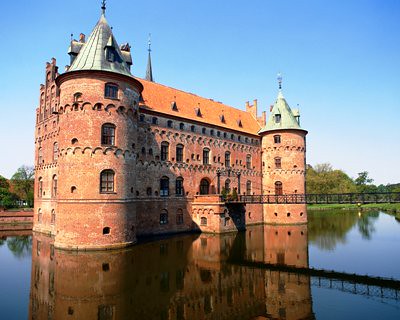
It’s not really much of a garden, huh? To me, walled garden is a good metaphor, but not totally accurate. For one, in most gardens, you can find your way around pretty easily. That’s not usually the case with learning management systems. As many have stated, LMS programs are more like boxes inside of boxes inside of boxes. Or, even worse – like a an old castle with a funny layout – including hidden passageways and trap doors. So that was one reason for choosing the castle image.
The other reason has to do with the walls. No matter how tall the walls around a garden are, you can still find a way to see over them because there is (usually) no roof. LMS programs are pretty closed systems from every angle, with only one way in – and that way can be removed at any time by the owner of the castle. Hopefully, now the usage of the above image makes more sense.
But let us also look at this thought of throwing out the baby with the bath water. Many people want to just dump the LMS and use Web2.0 tools to adminstrate everything. They usually quote their own experience as proof that the LMS is lost and in such a horrible state that it needs to be totally dumped. I want to take an honest look at this “in my experience” concept – something that I am just as guilty of doing. If you were able to look at even one school per day for five years – by visiting them, reading a new blog, making a phone call, etc – even on weekends, you are looking at 1820 schools. Even your most active full time conference speaker wouldn’t be able to accomplish that – so this is like the “gold standard” of experience. According to U.S. Census results, there are 129,404 schools and colleges in the U.S. So, even the “gold standard” of experience would only really interact with 1.4% of all schools in the U.S. in 5 years time – if they had no life! And this is just looking at schools – there are 6.8 million teachers in the U.S. alone. Each of them with a unique classroom situation of some sort.
Let’s also be honest about “birds of a feather flock together.” When we speak from our experience, we are probably mainly getting this experience from interacting with people that are like us. We tend to go to conferences that match our interests – so it would figure that of course we would run in to people that believe like us. I just say this to submit the idea that maybe our “experience” is extremely limited and possibly skewed a little bit. Maybe even a lot. Even those that travel a lot and read massive numbers of blogs.
We need to realize that our experience does speak to us that something needs to change – because if we want something different, someone else probably wants it, too. But we also need to realize our viewpoint is always limited – so don’t make it hard for those that the system is working for.
I think that this is a concept that those of us that like to look forward and innovate have a heard time swallowing: the system does work for some students the way it is. It just needs to be expanded and diversified to accommodate those that it doesn’t work for.
So what would that look like? Well, I laid that out in the last post on this subject, but I will expand on that further in the next post.
See other posts in this series
Formerly in this series:
Death of the Learning Management System? (part 5)
Death of the Learning Management System? (part 4)
Death of the Learning Management System? (part 3)
Death of the Learning Management System? (part 2)
Death of the Learning Management System? (part 1)

Matt is currently an Instructional Designer II at Orbis Education and a Part-Time Instructor at the University of Texas Rio Grande Valley. Previously he worked as a Learning Innovation Researcher with the UT Arlington LINK Research Lab. His work focuses on learning theory, Heutagogy, and learner agency. Matt holds a Ph.D. in Learning Technologies from the University of North Texas, a Master of Education in Educational Technology from UT Brownsville, and a Bachelors of Science in Education from Baylor University. His research interests include instructional design, learning pathways, sociocultural theory, heutagogy, virtual reality, and open networked learning. He has a background in instructional design and teaching at both the secondary and university levels and has been an active blogger and conference presenter. He also enjoys networking and collaborative efforts involving faculty, students, administration, and anyone involved in the education process.
I’m having a rough night… first I find out that we are moving into web 3.0 when I thought we had more or less just arrived in web 2.0. Now I find this term that seems to refer to me: “Edupunk.” I need to process this a little bit. Get used to the fact that at least in one part of my life, I can still be a punk. I thought I had ‘arrived’ irrevocably and the fossilization process begun… but there may be a part of my life in which I can still be a punk, which gives me hope. ;-)
Seriously, I like what you’re getting at Matt. I’m thinking of teaching my culture class next semester off of a blog instead of moodle and rethink a lot of its original content (form and content are difficult to separate in online courses as in literature, I suppose). But I don’t see myself going CRAZY with a million web 2.0 tools at once. If anything, I see myself scaling back a bit in terms of my strategies and tools and being a bit more minimalist as an instructor. In that regard, though I may not technically be using a LMS in the narrow sense of the word, I think I will be trying to chart some kind of middle course in which the blog structure functions as a LMS.
I have not theorized these choices or thought them through as carefully as you present your ideas here. But for a LMS to truly do what you say it should do, and serve instructors such as myself, it needs to be as easy to use, as natural to use, as blogs have become to younger teachers. (In my department over half of the professors –people who are not very tech minded– use blogs in all of their classes.) When LMS becomes that native to professors, then it will have arrived as a new standard for all courses, all live, hybrid and distance.
There definitely needs to be a simplification of the LMS interface. And I really hope they figure that out and get it right. But the other hard reality we have to face is that all of these products are consumer driven. They are the way they are in large part to end user demand. Even something as dense as Blackboard still had someone sitting there saying ‘our customers want this!’ (even though they got it wrong – they still thought that)
Even when we realize this, I don’t know if we will truly realize how that came about. When the powers that be saw the EduPunks leaving the LMS for blogs and wikis and other tools – what do you think they did? ‘Hey – we need to add those tools to our product!’ The sad truth is – EduPunks are probably most responsible for creating the ‘walled garden’ effect than anyone else. The more we leave the LMS behind, the more they are going to try and assimilate what we are leaving for… rather than trying to understand why we are leaving. That’s just the way businesses work.
So the battle is really within the confines of the LMS – trying to win other professors and EdTech people to our cause to get what you said here – an LMS that is native to professors, that allows them to teach in a way that their learners need to learn. Once the demand is there… once there is enough buzz being generated to getheir attentoin… then we will probably see the changes we need.
(it seems to me that I remember there being movies or TV shows about people that were at war with something and then found out that they were actually the creators of the faction they were at war with. Kind of like Terminator, but they didn’t know where the enemy cme from at first. Drawing a blank on what it is, thoug…)
Matt, interesting point about how business asimilate tools into the walled garden as edupunks migrate…
I wonder if there’s something else at work, and that is this: certain disciplines actually like walled gardens, or castles without gardens altogether. I mean, the avidness with which I have seen some people in the sciences and social sciences gravitate toward webct type things.
I attended a few teaching workshops in 2005 or 2006 where the divide between liberal arts and sciences seemed pretty stark.
The differences might be a little more micro than those general categories. I know English and Grammar teachers are huge proponents of adding blogging tools to LMS platforms, especially Moodle. I created a ‘Course Blog’ module for Moodle a while back, and the most popular feature that many use on it are student-only blogs, to where each student has a private blog that only the student and instructor can see. That is the walled garden to the extreme – but it is very popular idea with English people. It may just come down to personality preferences, but many disciplines are known to attract people of like personalities (take physical education for example).
But I am curious – what were those differences over in 2005/6? That is something interesting to look in to.
The high powered webCT users, from science, did not ‘get’ blogs or why anyone would want to use such a tool. It wasn’t a big deal, just a sense of disconnect between the camps. I could not understand their passion for the sealed boxes within boxes of webCT and they did not understand mine for blogs.
Yeah – I can see that. Science is all about creating the boxes :)